
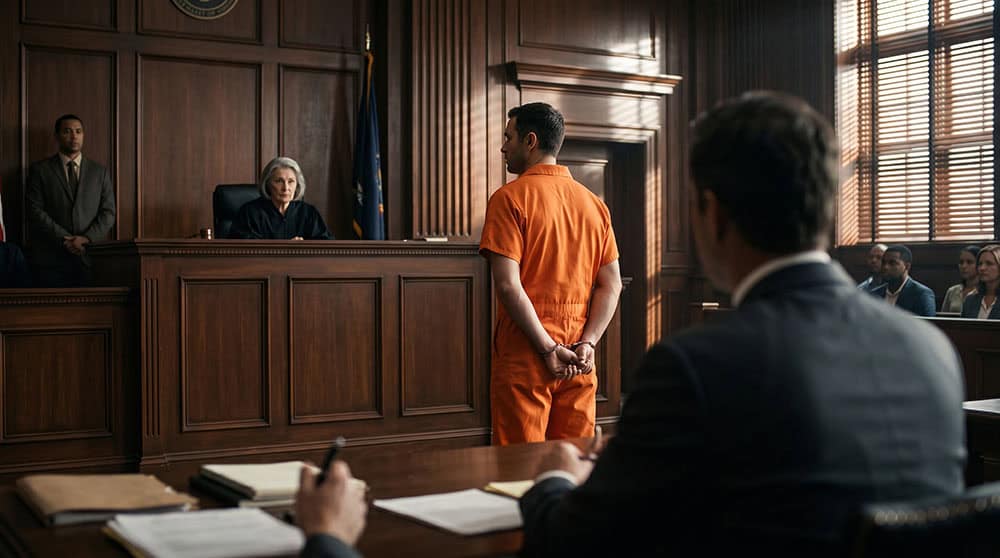
Being arrested or charged with a crime in New York does not automatically mean you will be convicted of the original charges. Depending on the facts, evidence, police conduct, witness testimony, and applicable law, criminal charges may sometimes be dismissed, reduced, or resolved through negotiations for a less serious offense.
For someone facing criminal charges on Long Island, one of the most important steps is determining how strong the prosecution’s case actually is. The allegations contained in a police report or charging document are only the beginning of the criminal process. A defense attorney can investigate what happened, review the prosecution’s evidence, identify legal problems, and determine whether there are grounds to challenge the charges.
New York law provides several potential avenues for challenging criminal charges, but every case is different. There is never a guarantee that charges will be reduced or dismissed.
Can Criminal Charges Be Dismissed in New York?
Yes. New York’s Criminal Procedure Law provides several circumstances under which a court may dismiss criminal charges.
For cases proceeding in a local criminal court, CPL § 170.30 allows a defendant to seek dismissal on grounds that can include a defective accusatory instrument, an untimely prosecution, denial of speedy-trial rights, a legal impediment to conviction, or circumstances justifying dismissal in the interest of justice.
For felony cases that have reached the indictment stage, CPL § 210.20 provides additional grounds for challenging an indictment or individual counts. These can include insufficient grand-jury evidence, defects in the grand-jury proceeding, speedy-trial violations, legal impediments to prosecution, and dismissal in the interest of justice.
Whether any of these grounds applies depends on the specific circumstances of the case.
Weak or Insufficient Evidence Can Affect the Charges
The prosecution has the burden of proving every required element of a criminal offense beyond a reasonable doubt at trial.
A defense attorney may therefore look closely at whether the available evidence actually supports each element of the offense charged.
Potential evidentiary weaknesses can include:
- Surveillance footage that contradicts the allegations
- Inconsistent witness statements
- A lack of physical or forensic evidence
- Problems connecting the defendant to the alleged crime
- Evidence supporting self-defense or another defense
- Missing records, photographs, video, or other documentation
- A timeline that does not support the prosecution’s theory
- Evidence that establishes only a less serious offense
In an indicted case, New York law specifically permits a challenge to the legal sufficiency of the evidence presented to the grand jury. In some circumstances, a court may reduce an indictment count to a lesser included offense when the evidence is insufficient for the greater charge but sufficient for the lesser offense.
The strength of the evidence can also play a major role in negotiations with prosecutors.
Constitutional Violations May Lead to Evidence Being Suppressed
Sometimes the central issue is not whether evidence exists, but how law enforcement obtained it.
The United States Constitution and New York law place limits on police searches, seizures, interrogations, and identification procedures. When evidence is obtained unlawfully, a defense attorney may file a motion asking the court to suppress it.
Under CPL § 710.20, potentially suppressible evidence can include property obtained through an unlawful search and seizure, certain improperly obtained statements, evidence derived from unlawfully obtained evidence, and certain improper identification evidence.
Examples of issues a defense attorney may investigate include:
- Whether police had lawful grounds to stop or detain someone
- Whether a search warrant was valid
- Whether a warrantless search was legally justified
- Whether consent to a search was actually voluntary
- Whether statements to police were obtained unlawfully
- Whether an identification procedure was improperly suggestive
- Whether evidence resulted from an earlier unlawful police action
If a suppression motion succeeds, the affected evidence cannot be used by the prosecution in the criminal action.
That does not automatically mean the entire case will be dismissed. However, if the suppressed evidence was critical to proving the charges, the prosecution may have a substantially weaker case. That can create opportunities for dismissal, a reduction in charges, or a more favorable negotiated resolution.
Witness Problems Can Weaken a Criminal Case
Witness testimony can be critical in assault, domestic violence, theft, harassment, robbery, and many other criminal cases.
However, witness testimony is not automatically reliable simply because an accusation was made.
A criminal defense attorney may examine:
- Inconsistencies between different statements
- Differences between a witness’s statement and video evidence
- Whether the witness could actually see or hear what occurred
- Bias or a motive to make a false accusation
- Prior contradictory statements
- Problems identifying the defendant
- Communications that contradict the allegations
- Whether other witnesses tell a different version of events
A witness changing their story or becoming unwilling to participate does not automatically require prosecutors to dismiss the case. Prosecutors may attempt to move forward using other admissible evidence.
However, serious credibility or availability problems can substantially affect the prosecution’s ability to prove its case and may become an important part of defense strategy or plea negotiations.
Discovery Can Reveal Problems With the Prosecution’s Case
Discovery is one of the most important stages of a New York criminal case.
Under Article 245 of the Criminal Procedure Law, prosecutors have significant obligations to provide discoverable information to the defense. Depending on the case, discovery may include defendant statements, witness information, police records, recordings, photographs, body-camera footage, electronic information, and other relevant materials.
Reviewing discovery may uncover evidence that was not apparent when the arrest occurred.
For example, body-camera footage could conflict with the police report. A witness may have made several inconsistent statements. Surveillance video might show that events occurred differently than alleged.
Discovery issues themselves can also become significant.
New York law provides remedies and sanctions for discovery violations. Depending on the circumstances and prejudice caused, a court can order additional discovery, grant more preparation time, exclude evidence, preclude testimony, give certain jury instructions, or impose other appropriate remedies. In sufficiently serious circumstances, dismissal of some or all charges can be an available remedy.
The prosecution’s certificate of compliance with discovery obligations can also affect whether it is considered ready for trial under New York’s speedy-trial rules.
Speedy-Trial Issues Can Lead to Dismissal
New York criminal cases cannot remain pending indefinitely without the prosecution meeting its legal obligations.
CPL § 30.30 establishes time limits relating to prosecutorial readiness for trial. The applicable period depends on the level of offense and other circumstances, and certain periods of delay may be excluded from the calculation.
For example, the statute generally provides a six-month readiness period when at least one charged offense is a felony, 90 days for certain misdemeanors punishable by more than three months in jail, and 60 days for certain other offenses. Calculating CPL § 30.30 time can be complicated because exclusions and other statutory rules may affect the final calculation.
When the prosecution exceeds the applicable statutory time without sufficient excludable time or another legal exception, a defense attorney may have grounds to seek dismissal.
Problems With an Indictment or Grand Jury Proceeding
Felony cases can involve another important stage: the grand jury.
Following an indictment, the defense may evaluate whether the prosecution presented legally sufficient evidence and whether the grand-jury proceeding complied with New York law.
CPL § 210.20 allows a defendant to seek dismissal of an indictment or count when, among other grounds, the evidence before the grand jury was legally insufficient or the grand-jury proceeding was defective.
These challenges are highly fact-specific, which is why careful review of the grand-jury record can be an important part of felony defense.
Can Charges Be Reduced Through Plea Negotiations?
Dismissal is not the only potentially favorable result in a criminal case.
Many cases are resolved through plea negotiations. Depending on the evidence, criminal history, severity of the allegations, mitigating circumstances, and other case-specific factors, prosecutors may agree to resolve a case through a plea to a less serious charge.
For indicted cases, CPL § 220.10 permits certain pleas to lesser included offenses with the consent of the prosecution and permission of the court, subject to statutory limitations for particular offenses.
A negotiated resolution might potentially involve:
- Reduction from a felony to a misdemeanor
- Reduction to a lower-level felony
- Reduction from one misdemeanor to a less serious misdemeanor
- Dismissal of certain counts
- A plea to one count while others are dismissed
- An agreed sentencing recommendation
- Other outcomes permitted under New York law
Whether negotiating a plea is advisable depends on the strength of the prosecution’s case, potential defenses, sentencing exposure, collateral consequences, and the client’s individual priorities.
A defendant should understand both the immediate and long-term consequences before accepting any plea.
What Factors Can Help a Defense Attorney Negotiate a Reduction?
There is no single formula for obtaining a reduced charge. Defense attorneys may use weaknesses in the prosecution’s case as well as mitigating information when advocating for a client.
Depending on the situation, relevant considerations might include:
- Lack of a prior criminal record
- Weak or contradictory evidence
- Problems with an eyewitness identification
- A complainant’s credibility
- Limited injuries or damages
- Evidence of self-defense
- Constitutional issues
- Successful suppression motions
- Discovery problems
- The defendant’s background and circumstances
- Rehabilitation efforts
- Restitution where appropriate
- The relative seriousness of the alleged conduct
Effective negotiation requires more than simply asking the prosecutor for a better offer. It often begins with understanding the evidence and identifying weaknesses that can be supported by facts and law.
Can a Case Be Dismissed in the Interest of Justice?
New York also permits courts, in limited circumstances, to dismiss charges in the interest or furtherance of justice.
This is different from arguing that the prosecution is legally incapable of proving the charge.
Under CPL §§ 170.40 and 210.40, courts may consider factors including the seriousness of the offense, harm caused, strength of the evidence, defendant’s history and circumstances, law-enforcement misconduct, community safety, the complainant’s position when appropriate, and whether a conviction would serve a useful purpose.
These motions require compelling circumstances and should not be viewed as an automatic option simply because a defendant has no prior criminal history.
Does a Dismissal Mean the Arrest Disappears?
When an entire New York criminal case terminates in a defendant’s favor through qualifying dispositions, CPL § 160.50 generally provides for sealing of the arrest and prosecution records, subject to statutory exceptions.
The specific consequences depend on how the case was resolved, so defendants should discuss sealing and record consequences with their attorney rather than assuming that every type of dismissal produces the same result.
Do Not Assume the Original Charges Will Be the Final Outcome
The charges filed immediately after an arrest do not always tell the complete story.
Evidence can change. Witness accounts can be challenged. Discovery may reveal inconsistencies. Police conduct may raise constitutional issues. An indictment may be vulnerable to a legal challenge. Prosecutors may agree to reduce charges after weaknesses in the case become apparent.
The earlier a criminal defense attorney becomes involved, the sooner the evidence and potential legal issues can be evaluated.
Speak With a Long Island Criminal Defense Attorney
If you have been arrested or charged with a crime in Suffolk County, Nassau County, or elsewhere on Long Island, do not assume that a conviction on the original charge is inevitable.
At Roche Law Group, we can review the allegations, examine the prosecution’s evidence, evaluate potential constitutional and procedural issues, and determine what defenses or options may be available based on the circumstances of your case.
Every criminal case is different, and no particular outcome can be guaranteed. However, understanding the weaknesses in the prosecution’s case can be critical when pursuing dismissal, reduced charges, or another favorable resolution.
Contact Roche Law Group today to discuss your criminal case with a Long Island criminal defense attorney.